What box build covers
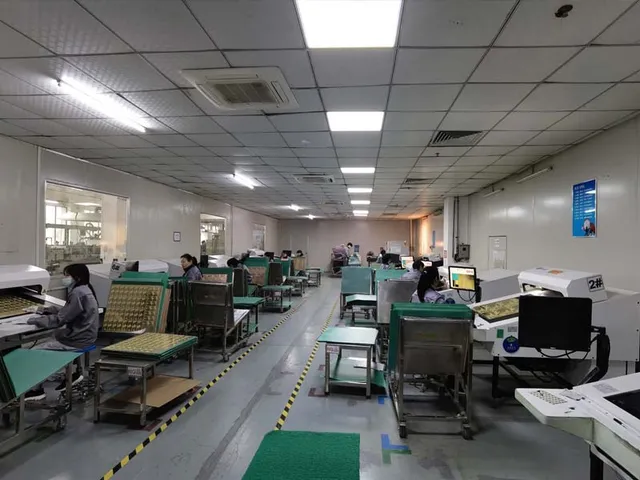
Box build takes a finished circuit board and turns it into a shippable product: wiring, mechanical assembly, software loading, testing and packing. Hitech Circuits runs box build in the same Shenzhen plant as PCB fabrication and assembly, so boards, harnesses and enclosures do not travel between suppliers — and a fault found at functional test is traced back to the board, the cable or the mechanical fit while the drawings are still open.
The range runs from fitting a finished PCBA into a simple enclosure with a display and user interface, up to a complete machine carrying tens of thousands of parts and hundreds of sub-assemblies.
Typical scope of work
- Sub-level product assembly — mechanical build of modules and sub-assemblies to the customer drawing.
- Cable and wire harness assembly — cut, crimped, labelled and continuity-tested to the harness drawing.
- Cabinet and enclosure assembly — chassis, panels, hardware, gaskets and legends.
- Firmware loading and configuration — programming, product settings and serial-number registration.
- Test — in-circuit, functional, final, environmental and burn-in test to the customer procedure.
- Packaging — retail or bulk packing, labelling and bar coding, with accessories included.
Bought-in parts
Mechanical and electrical parts are procured as part of the same order: pneumatics, PLCs, switches, timers and encoders, plus plastics, custom metalwork and machined products. Enclosures and metalwork are made to drawing, so the fit is checked against the PCBA during the first-article build rather than discovered on the customer's bench.
Test and traceability
Every unit passes through in-circuit test, flying probe and automated optical inspection, with X-ray (AXI) used for joints hidden under BGA and QFN packages; functional, final, environmental and burn-in test then run against the procedure supplied with the order. Serial numbers tie each unit back to its board batch, component lots and test records, and warehousing and order fulfilment follow the delivery schedule agreed at quotation.
Where the board order ends and the box build starts
A finished unit can be assembled almost anywhere; the routing question is not capacity but who owns the interface — the point where a working board meets a harness, an enclosure and a firmware image, and where a failure can belong to any of the three.
- One quality system across the interface — where the board, the harness and the metalwork come out of the same system, a unit that fails functional test is traced to the process that produced it. Split across suppliers, the same failure is argued between them, and the argument usually lands after the drawings have closed.
- Board supply can come from anywhere — turnkey or consignment PCBA, from this plant or from another, as long as the mechanical drawing, the harness drawing, the firmware image and the test specification travel with it; small-batch and volume assembly describes how a board order hands over to the build.
- Keep the final build near the market when configuration is local — units that are set up per market (labels, cordsets, language packs) or serviced in the region are often better finished close to the customer, with tested sub-assemblies shipped and packed for local integration.
- Split where the mechanics already have a supplier — a standard enclosure bought under its own agreement, or metalwork already tooled elsewhere, can stay there; the fit is then checked at the first article instead of being assumed from a drawing.
What to send with an enquiry
The PCBA data package (Gerber set, BOM and pick-and-place file), the mechanical and harness drawings, the bill of materials for bought-in mechanical parts, the firmware image and the test specification. Cable lengths, enclosure fits and test steps are all derived from those files — missing documents are queried rather than assumed.
Where a box build stalls before the line starts
Few box build delays are line problems. Most are documents that disagree with each other, and they surface at the first article, once the parts are bought and the enclosure is on the bench.
- A mechanical drawing that does not match the PCBA — connector positions, board thickness, stand-off height and assembly sequence all have to agree with the fabrication data; a connector that clears the panel on paper can foul it on the board, and the sequence decides whether the last screw is reachable at all.
- A harness drawing without length, tolerance or crimp data — a harness made to an outline fits one unit and not the next, so wire lengths, bundle break-outs, terminal and seal part numbers and the continuity check belong on the drawing rather than in a conversation.
- A firmware image with no version identity — programming needs a file that can be tied to the unit's serial number and to the test specification it was written against, otherwise an engineering build and a released build look the same at the bench.
- A test specification that says only "functional" — a verdict needs the stimulus, the limits and the record format, or the unit is switched on, seen to work and shipped; the gates themselves are on PCBA testing and quality assurance.
- Labels, bar codes and packing content left to the end — serial-number rules, bar code format, accessory list and packing configuration decide how a unit is registered and traced, and adding them afterwards means re-opening packed units.
- A mechanical bill of materials without finish or tolerance — plating, coating colour and tolerance class decide whether a part fits and whether the unit passes cosmetic inspection, so both belong beside the part number.
Process limits used for the quotation are on the capability page.
Related services
PCB assembly services cover the board itself, components sourcing covers the BOM, and PCBA testing and quality assurance covers the test gates that a box build inherits.