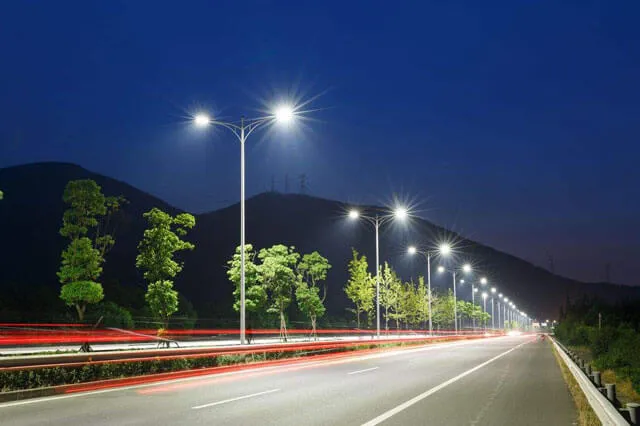
LED lighting is a heat problem wearing an electrical hat. Junction temperature drives light output, colour shift and lifetime, so a board that measures correctly on the bench can still fail in the field because the heat had nowhere to go. That is why the substrate and the thermal path are settled before the circuit is optimised.
Heat leaves through the board, not the air
Inside a sealed fixture there is very little convection. The heat path has to run from the LED pad through the dielectric into a metal base, and from there into the housing. Thermal vias, heavy copper planes and a metal backing are the three levers; a ceramic substrate is the option when the power density or the ambient temperature goes beyond what a metal-core laminate can hold. The published process limits are on the capability page, and they apply to every industry rather than to lighting alone.
Choosing the substrate
Aluminium base laminate is the working default for general lighting: it spreads heat well and keeps the cost of a large fixture reasonable. Copper base is chosen where conduction has to be better or where the mechanical design uses the board as a structural part. Ceramic covers the highest power densities, the widest temperature range and the designs where electrical isolation has to survive heat at the same time. The decision is made with engineering, on the thermal model, before the stack-up is frozen.
Where a lighting programme stops being a board problem
A luminaire is approved on light as much as on current. Luminous flux, colour point and colour rendering are set by the emitter, the optic and the driver, and the board only has to hold the junction temperature at which those figures were promised. A lighting enquiry that arrives with a board outline and a stack-up but no flux target and no junction temperature is answered against the wrong constraint: the thermal design is bent to fit a housing that was already chosen, and the shortfall turns up afterwards on a photometric test.
Heat has to be sized on the duty the fixture really sees. A luminaire that spends most of its life dimmed runs cooler than one held at full output, a pulsed driver loads the board differently from a constant current, and a sealed outdoor housing adds an ambient rise that an indoor ceiling does not. The thermal model is therefore built on the worst sustained case rather than on the nameplate wattage, because the case that fails in the field is the one the datasheet does not describe.
Sealing and mounting belong to the same decision. An ingress-protected fixture asks for conformal coating, potting or a gasket, and each of those closes part of the path the heat was using; a metal housing works as a heatsink or as an insulator depending on how the board is fixed to it. The boundary in a lighting programme runs through the light and the enclosure rather than through the layer count — settle those two before the stack-up is frozen and the board only has to be built once.
Assembly, coating and the fixture
LED boards usually carry parts that decide the assembly method: connectors that have to take a cable pull, optics that sit over the emitter, and driver sections that mix fine-pitch control with heavy copper. The board is assembled in house, then conformal coating, cable and harness work, firmware loading, functional and burn-in test and box build follow in the same plant, so a fixture can leave as one tested unit.
Records, confidentiality and visits
Fabrication and assembly share one plant, so one lot record covers the bare board, the material batch and the assembled fixture, and the inspection sequence behind it is on quality assurance. The certificate set — ISO 9001:2015, ISO 14001, ISO 45001 and UL file E354070 — is scanned on the certifications page.
Drawings can travel under a mutual NDA from the first exchange, and a visit to the Shenzhen or Meizhou plant can be arranged around the processes the fixture would use. Payment is by bank transfer (T/T), with goods quoted EXW Shenzhen or DDP.
What a lighting quotation is actually pricing
Two quotations for the same Gerber set rarely differ by board area. They differ by how much of the thermal and fixture-level proof has been turned into a measurable step, and that work is priced alongside the fabrication.
- Making the thermal path measurable. Copper weight, dielectric thickness and via fill are checked so that the board delivers the resistance the model assumed, and coupons and micro-sections show what the laminate actually does. Junction temperature at fixture level is measured by the customer or by the photometric test house; what the board side can prove is that the path it was asked for is the path that was built.
- Building and testing the fixture, not only the board. Coating, cable and harness, firmware loading, functional test and burn-in follow on the same site, in the sequence described under PCBA testing and quality assurance, so a luminaire arrives as a tested unit and the first switch-on does not happen in the customer's incoming area.
- Re-confirmation after a change. A new emitter, a different optic or a revised driver changes the heat and the current, so a revision returns to the confirmed state and is re-run and re-recorded instead of being released as a drawing update and found out in the field.
Price and evidence move together here as well. An order that carries less of the second is not cheaper in total — it hands the thermal and fixture-level confirmation back to the lighting programme, where it is paid for again during photometric testing or after the first failure instead of being issued as the goods leave the line.
Next step
Send the Gerber set, the thermal requirement, the BOM if assembly is included, the quantity and the target date. Board families used in lighting work have their own pages — aluminium and metal-core, heavy copper and ceramic — and box build covers the fixture. Lighting sections inside vehicle programmes are described under automotive and vehicle PCBs, the rest of the industries we serve are on the industries page, and a quote can be requested on the contact page.