Four gates, not one final inspection
Testing a batch at the end of the line only tells you how many boards are already scrap. Quality is therefore built into four gates:
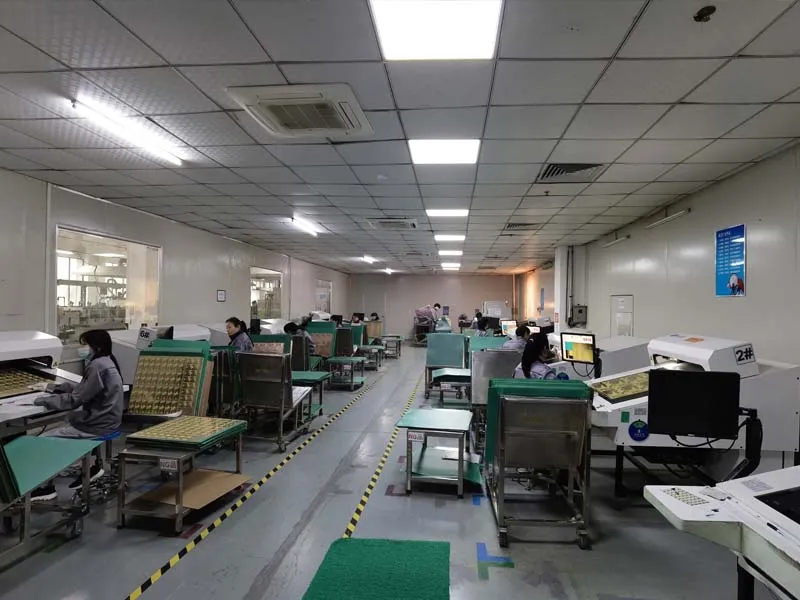
- IQC — incoming quality control. Components and bare boards are checked on arrival, before they can reach a feeder. A wrong reel caught here costs a phone call; the same reel caught after reflow costs a lot.
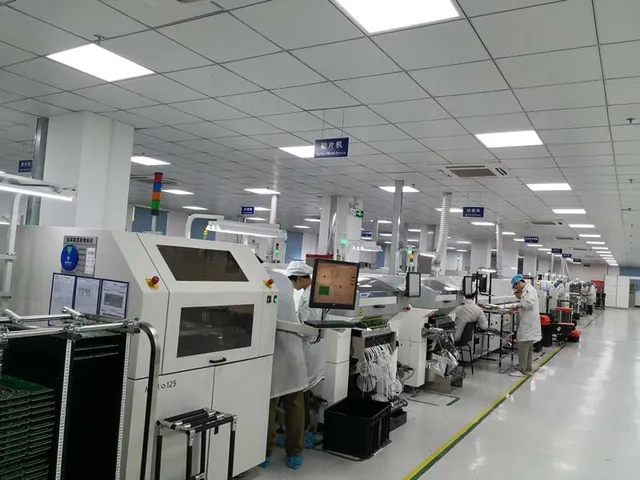
- IPQC — in-process quality control. Each process is inspected as it runs, so a printing or placement problem is corrected within the lot rather than after the whole batch has been assembled.
- QC — test and inspection. The finished assembly is tested and inspected, with a first article inspection on every process and workmanship judged against IPC-A-610.
- QA — final quality assurance. A sample inspection plan releases the lot, reviewing the records from the gates behind it.
Inspection along the line
Optical and X-ray inspection cover what the eye cannot reach. Solder paste inspection runs before placement, checking volume and alignment; automated optical inspection runs after reflow, catching missing, offset and tombstoned parts; X-ray inspection looks at the joints hidden under BGA, QFN and other area-array packages, including voiding and bridging that no optical check can see.
Ionic contamination is measured by ionograph down to ppm per square centimetre — the residues that pass every electrical test on the day of assembly and cause electrochemical failure months later in the field.
Electrical and functional test
In-circuit test drives the assembled board through a bed-of-nails fixture, checking component presence, value and orientation as well as opens and shorts. Flying probe does the same job without a fixture, which suits prototypes and small batches where the fixture cost would not be recovered; a manufacturing defect analyser narrows failed boards down to opens, shorts, missing or reversed parts.
Functional test is where the product is proved to work: the assembly is exercised on a fixture built to the customer's test points and test steps, with the acceptance criteria taken from the customer procedure. Firmware is loaded and the product configured as part of the same stage, so a board that leaves test is a working unit.
Reliability testing
Where the application demands it — automotive, medical, industrial and outdoor products in particular — boards go through burn-in, thermal cycling, hi-pot and vibration testing alongside reliability checks on the process itself. These are run alongside, not instead of, the inspection gates: a product can pass every electrical test and still fail a thermal cycle, and the point of running both is to find that out before the customer does.
When testing is the whole order
Most testing happens inside an assembly order. Sometimes the testing is the order, and that changes who carries the judgement.
- The boards are not built yet. Then the test is the last stage of an assembly programme rather than a service of its own: it belongs inside PCB assembly services and runs alongside the build.
- The boards are built and need a verdict. Screening what has already been assembled, burning in, locating a failure and confirming a repair stands on its own, on one condition — there is a written acceptance criterion to test against.
- The same failure returns every lot. More coverage will not remove it. The cause sits in the design or in the process, which makes DFT review the next step rather than a longer test list.
- The verdict covers a whole unit. Proving a finished product — wiring, housing, firmware and packing included — is final assembly work, not board test.
- The failure is a wrong part. Testing catches it late and one board at a time; incoming inspection catches it while a phone call still settles the problem.
Two boundaries are worth stating plainly. "Please test this board", with no criterion attached, is not an order: a test that cannot return a pass or a fail produces data, not a decision. And a test report proves a lot, never a design, so it does not replace a design review.
What settles most of these cases is who owns the risk of a board-level failure. If the verdict stays with the customer, the station is gathering evidence on their behalf. If the plant owns it, the order is a quality-assurance order, and the acceptance limits have to be agreed before the first lot rather than adjusted afterwards.
What sets the price of a test programme
Testing is quoted as a programme, not as a unit rate on board count. Six things move the number before the quantity does.
- The fixture. A bed-of-nails or functional fixture is built once and amortised over every lot that shares the same design; a revision that moves test points can retire it.
- The programme and its limits. Deciding what the test must reach, and what counts as a pass, is engineering time — deeper coverage takes longer before the first lot runs.
- Time on the station. Each board holds a station for the length of its test, so cycle time against lot size, rather than lot size alone, is what a programme really costs.
- Coverage traded against complexity. Reaching more nodes means more probes and often a fixture that contacts both sides, so the cheapest test is rarely the one that checks the most.
- What happens after a failure. A failed board has to be located, repaired and tested again; the looser the acceptance limit, the larger the share of the price that lands in re-test.
- Comparability. Two quotations compare only on the same programme version, the same fixture and the same limits — otherwise one of them is pricing something else.
So a test quotation holds three things at once: the scope of the test, the volume it amortises over, and the side that carries the verdict. Read as a unit price, all three disappear.
Specifying the test with the build
Test requirements are easier to agree before assembly than after. Send the test points, the test steps and the pass criteria with the Gerber set and the BOM, and the fixture, the program and the acceptance limits are prepared alongside the build; where only a functional description exists, the DFT review works out what the tester has to reach and what failures the product actually produces.
Boards are held to IPC-A-610 workmanship, and the plants behind them are certified to ISO 9001:2015, IATF 16949:2016 and ISO 13485:2016 for automotive and medical programs — see the certifications page for the issued certificates, and the capability page for the process limits the inspection plan is built against.